
Buy Indian Sweets for Diwali 2026 in Dubai: Fresh Mithai Boxes & Ordering Guide
Diwali 2026 falls on Sunday, 8 November, and in Dubai that changes how you plan...
Read More
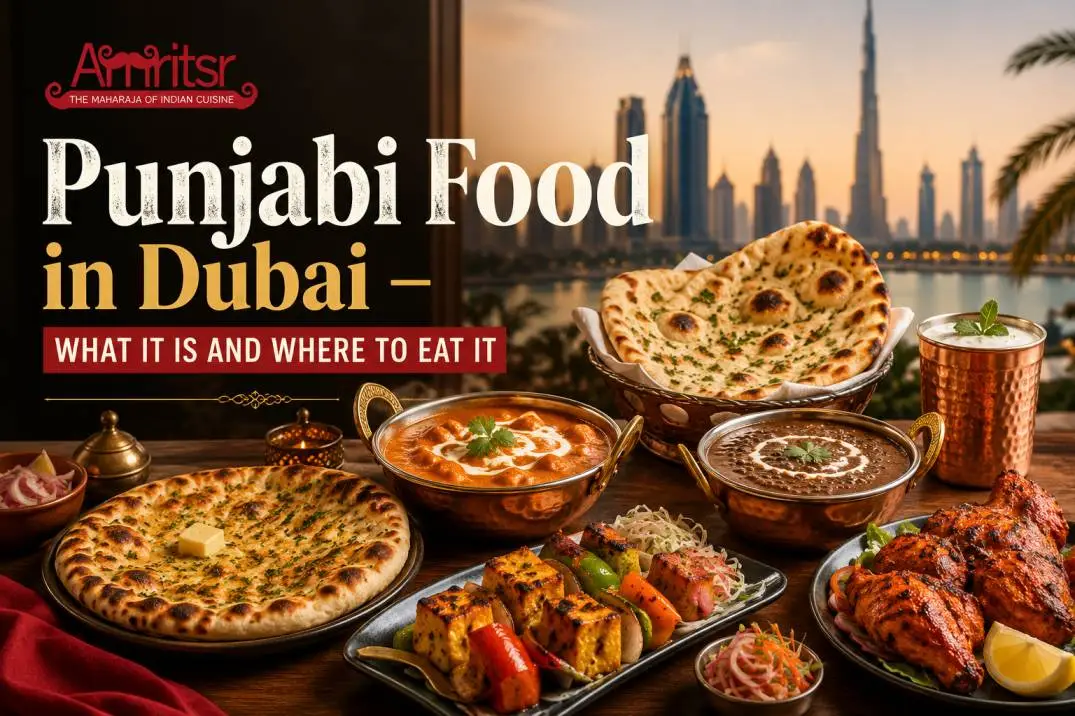
Not all Indian food is the same. This sounds obvious, but it is a distinction that gets lost when people talk about “Indian restaurants” as if they are a single category. India has dozens of distinct regional cuisines, each shaped by local geography, agriculture, religion, and history. They share some ingredients and techniques, but they are as different from each other as Italian food is from Spanish.
Punjabi food is one of the most celebrated of these regional cuisines — and one of the most misunderstood. It is the cuisine that most people picture when they think of Indian food: rich gravies, tandoor-baked bread, bold spices, generous portions. But Punjabi food has a depth and specificity that goes well beyond butter chicken and naan. Understanding what makes it distinctive is the first step to appreciating what a properly executed Punjabi meal can be.
This guide explains what Punjabi food actually is, what separates it from other Indian cuisines, what to order, and where to find the real thing in Dubai.
Punjab is a region in northwestern India (and eastern Pakistan) that has historically been one of the most fertile agricultural areas on the subcontinent. The name itself means “five rivers” — a reference to the five rivers that water the land and make it exceptionally productive.
This agricultural abundance shaped the cuisine directly. Punjab produces wheat, dairy, pulses, mustard, and a wide variety of vegetables in quantities that historically exceeded local need. The food culture that developed here reflects that abundance — large portions, generous use of dairy (ghee, butter, yoghurt, cream), wheat-based breads, and dishes designed to be filling and sustaining for people working physically demanding agricultural lives.
Punjabi cuisine is also shaped by its position as a crossroads. Punjab sits at the top of the Indian subcontinent, on the route that connected Central Asia to the rest of the Indian landmass. Centuries of cultural exchange — including the influence of Mughal cooking — layered additional depth into the food, particularly in the use of whole spices, slow-cooking techniques, and the tandoor oven.
The result is a cuisine that is rich, bold, deeply flavoured, and built around a philosophy of generosity.
No Indian regional cuisine uses dairy as extensively as Punjabi food. Ghee (clarified butter), white butter (makhan), full-fat yoghurt, fresh cream, and paneer (fresh Indian cheese) appear throughout the menu — not as occasional additions, but as central ingredients.
Dal makhani — whole black lentils slow-cooked with butter and cream — is essentially a dairy delivery system wrapped around lentils. Butter chicken gets its character from the cream and butter in the sauce. Amritsari kulcha is served with a pat of white butter that melts into the hot bread the moment it arrives. Lassi — the cold yoghurt drink that is Punjab’s answer to every digestive need — is made with thick, full-fat yoghurt and nothing diluted.
South Indian food, by contrast, uses coconut oil and coconut milk as its primary fats. Bengali food leans on mustard oil. Rajasthani food uses ghee heavily but not dairy in the same breadth. Punjabi food is uniquely dairy-saturated, and this is a primary reason it tastes the way it does.
The tandoor is a clay oven that originated in Central Asia and became central to Punjabi cooking. It reaches temperatures of 400–500°C — far higher than any conventional oven — and cooks food through a combination of direct high heat, radiant heat from the clay walls, and live flame.
Bread cooked in a tandoor develops a texture and flavour that cannot be replicated any other way. The outside blisters and chars slightly where it contacts the tandoor wall; the inside stays soft and slightly chewy. Meat cooked in a tandoor gets a smoky, slightly charred exterior while remaining moist inside — the result of cooking quickly at very high heat.
The tandoor is used across parts of northern India and Pakistan, but Punjabi cuisine built its entire bread and kebab tradition around it. Tandoori roti, naan, kulcha, paratha, seekh kebab, tandoori chicken — these are all products of a cooking tradition that treats the tandoor as the centrepiece of the kitchen. To understand the full range of North Indian restaurants in Dubai and how they use the tandoor, it is worth exploring what separates authentic Punjabi cooking from a generic North Indian menu.
While the tandoor operates at extreme heat, much of Punjabi cuisine’s depth comes from the opposite principle — extremely slow cooking at very low temperatures.
Dal makhani is the clearest example. The dish is traditionally cooked overnight on a wood fire, the lentils simmering slowly for eight to twelve hours until they break down into a thick, velvety texture and the flavours integrate completely. No amount of pressure-cooking or shortcuts produces the same result. The depth in a properly made dal makhani is a product of time.
The same applies to Punjabi chole — the spiced chickpea curry served with kulcha and bhature. Well-made chole should be dark mahogany in colour, thick, and deeply flavoured from hours of simmering with whole spices. The colour is the most reliable visual indicator: pale, thin chole was cooked quickly. Dark, thick chole was cooked properly.
Most of South India and Bengal built their food culture around rice. Punjab built its around wheat. The bread tradition in Punjabi cuisine is unmatched in its variety and depth — roti, paratha, naan, puri, bhatura, kulcha, missi roti, makki di roti (cornmeal flatbread). Each bread has a specific context, a specific method, and specific accompaniments.
Makki di roti (a flatbread made from corn flour) with sarson da saag (slow-cooked mustard greens) is one of Punjab’s most iconic dish combinations — a winter staple that is deeply rooted in the agricultural calendar. Bread is not a side item in Punjabi cuisine. It is the vehicle through which the meal is experienced.
The signature dish of the city of Amritsar — and the namesake of Amritsr Restaurant in Dubai. A leavened bread stuffed with spiced potato, paneer, or a combination of both, baked directly against the wall of a tandoor until the outside blisters and chars. Served with chole (slow-cooked spiced chickpeas), raw onion rings, green chilli, and a pat of white butter.
The combination is precise and designed — each element balancing the others. The richness of the bread and butter is cut by the acidity of the chole. The raw onion adds sharpness. The chilli adds heat. It is a complete, balanced eating experience compressed into one plate. If you want a deeper look at what makes this dish different, the authentic Indian food in Dubai guide covers the cooking techniques behind it in detail.
Whole black lentils (urad dal) and kidney beans, slow-cooked for hours with butter, cream, ginger, garlic, and tomatoes. The dish should be thick, dark, and silky. It is one of those recipes where the quality of the execution is immediately obvious — there is no hiding a rushed dal makhani.
Spiced chickpea curry with deep-fried puffed bread. The chole must be dark and thick from long cooking. The bhatura should arrive freshly fried, puffed up and slightly crisp at the edges. Together, this is one of North India’s most beloved meal combinations. It is also one of the most popular Indian breakfast dishes in Dubai — served from 6 AM at Amritsr and a particular favourite for early morning diners.
Technically a Delhi invention but adopted comprehensively into Punjabi restaurant culture. Chicken cooked in a smooth, mildly spiced tomato and cream sauce. Well-made butter chicken should have a sauce that is balanced — not too sweet, not too thin, with a depth from the tomato that holds up against the cream. It is one of the most accessible entry points into Punjabi food for anyone unfamiliar with the cuisine. For a full breakdown of the best Indian dishes to try in Dubai, including butter chicken and its variations, that guide covers the full spectrum.
Slow-cooked mustard greens with ginger, garlic, and green chilli, eaten with cornmeal flatbread and white butter. This is arguably the most rooted dish in Punjabi food culture — a winter combination that connects the cuisine directly to Punjab’s agricultural landscape. When done well, it is deeply warming, earthy, and unlike anything else in Indian food.
Chicken marinated in yoghurt, ginger, garlic, and spices, cooked in a tandoor. The marinade tenderises the meat and creates the characteristic red-orange colour. The tandoor chars the outside slightly and keeps the inside moist. Served with mint chutney and raw onion. Simple, excellent, and a direct expression of what the tandoor can do.
Punjab’s most famous drink. Thick, cold, made with full-fat yoghurt. Sweet lassi is the classic version — yoghurt blended with sugar, sometimes with cardamom or rose water. Salted lassi with cumin is the savoury alternative. Both are excellent alongside spiced food, and both are deeply embedded in Punjabi food culture as the natural companion to a full meal.
Dubai has one of the largest Punjabi communities outside of India. Many of the Indian expats who have lived in Dubai for decades are from Punjab — they grew up eating this food, they know exactly what it should taste like, and they do not accept imitations.
This creates a form of quality enforcement that works entirely in the diner’s favour. A Punjabi restaurant in Dubai cannot cut corners on its dal makhani or its kulcha and expect to keep its regulars. The community will notice immediately and move on. The restaurants that have survived in areas like Al Karama for many years have done so because they maintained their standards consistently in front of the most demanding possible audience.
Al Karama is the neighbourhood where this standard is highest. It is Dubai’s most established Indian dining area, and Indian restaurants in Al Karama are accountable to a community that eats Indian food every day. For anyone looking for Punjabi food in Dubai specifically, Al Karama is the right address.
If you are visiting Dubai and have not eaten Punjabi food before, the cuisine can look overwhelming from the outside. Long menus, unfamiliar names, and a wide range of dishes that all sound similar on paper.
The simplest approach is to start with one of three combinations:
For the full Punjabi experience: Amritsari kulcha with chole, a glass of sweet lassi, and a portion of dal makhani. This covers the cuisine’s core identity — tandoor bread, slow-cooked legumes, and dairy — in a single meal.
For something lighter: Aloo paratha with yoghurt and pickle. Simple, honest, and a good entry point into Punjabi bread culture without the full richness of kulcha and chole.
For a shared meal: Order tandoori chicken or seekh kebab as a starter, butter chicken and dal makhani as mains, naan to share, and lassi to drink. This is the combination that most people mean when they picture a North Indian restaurant meal.
For tourists specifically, the Indian food in Dubai tourist guide covers what to order, how to navigate the spice levels, and what to expect when you sit down — a useful read before your first visit.
Amritsr Restaurant in Al Karama has been serving authentic Punjabi and North Indian food in Dubai for over 20 years. The restaurant is named after Amritsar — the cultural heart of Punjab and one of India’s most celebrated food cities — and the menu reflects that specific culinary heritage rather than a generalised North Indian spread.
The kitchen uses a working tandoor. The dal makhani is slow-cooked. The kulcha comes directly from the tandoor wall. The lassi is made with full-fat yoghurt. These are the operational standards that produce the kind of Punjabi food that Dubai’s Indian community has been coming back to for two decades.
For a late-night craving, Amritsr is also one of the few 24-hour Indian restaurants in Dubai — open round the clock, every day of the week. And if you prefer eating at home, Indian food delivery in Dubai is available directly through their online ordering platform.
What to order on your first visit: The Amritsari kulcha with chole is the essential starting point — it is the signature dish and the clearest expression of what this restaurant does best. Add a glass of sweet lassi and a portion of dal makhani to complete the meal.
Address: Al Attar Center, 318-836, Al Karama, Dubai (opposite Spinneys) Phone: +971 4 327 8622 / +971 50 6780096 Timings: Open 24 hours, 7 days a week Order Online: orders.amritsruae.com
What is Punjabi food?
Punjabi food is the regional cuisine of Punjab, a state in northwestern India. It is characterised by generous use of dairy (ghee, butter, yoghurt, cream), wheat-based breads cooked in a tandoor oven, slow-cooked lentil and chickpea dishes, and bold, layered spicing. It is the cuisine that most people associate with North Indian food — dishes like butter chicken, dal makhani, tandoori chicken, and naan all have Punjabi roots.
How is Punjabi food different from other Indian food?
Punjabi food stands out from other Indian regional cuisines primarily through its heavy use of dairy, its dependence on the tandoor for bread and grilled dishes, and its tradition of slow-cooked gravies and lentils. South Indian food uses coconut and rice as its foundations. Punjabi food is built around wheat, dairy, and the tandoor. The flavour profile is rich, bold, and warming rather than sour, coconut-forward, or rice-based.
Is Punjabi food available in Dubai?
Yes. Dubai has a large Punjabi community and several restaurants that specialise specifically in Punjabi cuisine. Amritsr Restaurant in Al Karama is one of the most established, having served authentic Punjabi food in Dubai for over 20 years.
What is the most famous Punjabi dish?
Amritsari kulcha, dal makhani, butter chicken, chole bhature, and sarson da saag with makki di roti are among the most celebrated Punjabi dishes. In the context of Dubai, Amritsari kulcha and dal makhani are the dishes most closely associated with authentic Punjabi restaurant cooking.
Is Punjabi food suitable for vegetarians?
Yes. Punjabi cuisine has a strong vegetarian tradition. Dal makhani, chole, paneer dishes, sarson da saag, and all the bread options are vegetarian. Many of Punjab’s most celebrated dishes contain no meat at all.
Where is the best Punjabi restaurant in Dubai?
Amritsr Restaurant in Al Karama, Dubai, is widely regarded as one of the most authentic Punjabi restaurants in the city. It has been serving traditional Punjabi and North Indian cuisine for over 20 years and is open 24 hours a day.
Punjabi food is not simply “Indian food.” It is a specific, deeply developed culinary tradition shaped by centuries of agricultural abundance, cultural exchange, and a cooking philosophy that prizes generosity, patience, and flavour above all else. In Dubai, that tradition is kept alive by a community of Punjabis who know exactly what the food should taste like — and by restaurants like Amritsr that have spent two decades meeting that standard.
Amritsr Restaurant Al Attar Center, 318-836, Al Karama, Dubai (opposite Spinneys) Open 24 hours | +971 4 327 8622 Order Online | View Menu | Find Us